
Are You Ready For Turkey Season?

April is wild turkey time. Seasons begin this month, though some have already started in early March, notably in Florida where hunters pursue the Osceola subspecies. Nationwide, almost all the seasons end the last day of May.
Now is the time to prepare for turkey hunting, but before we discuss calls, gear, and hunting strategies, it’s essential to first determine where you’ll hunt. This is a no brainer if you already hunt a certain area or are going with a friend who knows a spot. But if you’ve recently moved to a new state or region, you might not have any idea where to go, or perhaps you’re a newcomer to turkey hunting and have no friends who hunt turkeys.
Much hunting is done on private land where permission is required from the landowner. Having said that, there are also millions of acres of land administered by state and federal governments where hunting is free. Problem is, much of that free land is heavily hunted, especially small state wildlife management areas. National forests around the country offer millions of acres of free hunting, particularly in the foothills and lower elevations with far less crowding. Mobile apps such as OnX and Huntstand will help you locate and pinpoint areas where you may be able to hunt.
One way to learn about hunting spots, as well as turkey hunting techniques, is to attend banquets sponsored by the National Wild Turkey Federation which has more than 250,000 members nationwide. Banquets are held around the country, featuring dinner, auctions, exhibitors and hunters, all who have the common thread of hunting turkeys. I’ve found that most of these folks are friendly and very willing to help newcomers learn about turkey hunting as well as finding places to hunt the big birds.

Once you’ve determined where you’ll hunt, you’ll need to check out your gear. Many hunters don’t bother to pattern their shotguns, but it’s always a good idea to do so, especially if you’re using different ammo. Some hunters will stand up a big piece of cardboard and draw a bullseye in the middle, stand back 30 yards and let fly. Problem is, you don’t know where the pellets hit the nonexistent bird. Buy a full-size turkey target, aim at the neck about eight inches below the head and then check your pattern. The pellet string tends to fly high which accounts for many misses when the hunter aims for the head, especially if the bird is close.
Be sure your turkey calls are in good working order. Many box calls require chalk to work effectively. Try the calls and make sure they sound right. Lying in the dust of the basement, garage or attic might affect their tone.
Try on your camo clothes. If you’ve gained weight since last turkey season now is the time to find out and replace your garments. Camo gloves, masks and hats are as important as your clothes. Be certain you can find them.
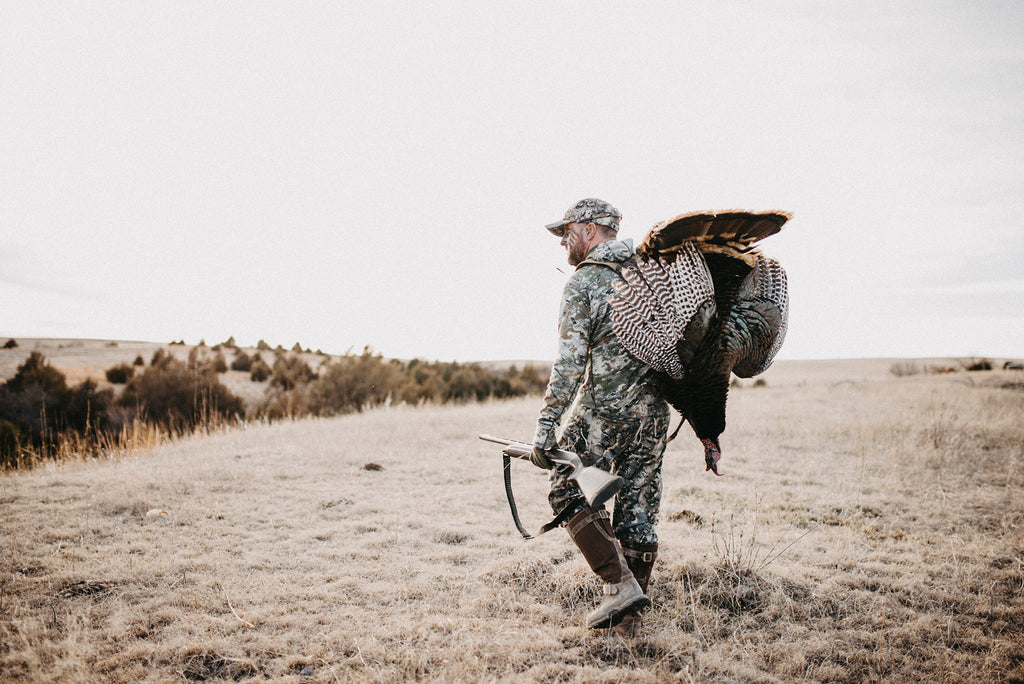
If you don’t have a vest, you might consider getting one. They’ll hold all your calls and other items in strategically placed pockets that accommodate your gear. A small lightweight stool works nicely to keep you off the ground, especially if it’s wet or snow covered.
I like to carry a medium sized CARIBOU GEAR game bag to protect my bird from dirt, pine needles and excessive heat. Whenever possible I’ll skin my turkey as soon as I show it off to my companions for bragging rights. A warm bird is far easier to skin or pluck than one that’s cold and stiff. Be aware that states have different laws that require you to leave a part of the bird naturally attached in order to determine its sex. Most of the time you must leave a fully feathered leg, but some states may require you to leave the head or a wing attached.
It’s always a good idea to remove the turkeys innards as soon as possible. I’ve seen several instances where birds are left intact for a day or more without being dressed. While birds are physically different than mammals and some hunters believe hanging them with guts inside is a good way to age them, my preference is to get the entrails out quickly.
Another item is insect repellent. Mosquitoes typically aren’t around yet in early spring in the northern climates but you’re apt to deal with ticks everywhere and chiggers in the south.
Safety is always of the utmost importance, especially in the turkey woods. Statistics show that in popular turkey states, up to 35% of the hunting accidents occur among turkey hunters. It’s easy to understand why. Hunters wear camo from their heads to their ankles. When they call they sound like a turkey. That in itself is enough to attract other hunters, especially if you’re using decoys. A careless hunter may see the decoys, hear you call, and have no idea a human is in the vicinity. An accident is waiting to happen if that person does something really stupid— such as take a shot at you if you move. It’s happened many times.
Hunter Safety instructors tell you to sit with your back against a large tree which will protect you if someone shoots at you from behind. It’s also recommended that you never wear anything that’s red, white, or blue which is the color of a tom’s head when he’s aroused. Wearing an orange hat when you walk in the woods and leave is a good idea. Trade it for your camo hat when you sit.
Stalking a turkey that you see or hear seems to be a plausible strategy but it’s also responsible for many mistaken shots at people. In fact, it’s so dangerous that it’s outlawed in half a dozen states. In those states you must go to your calling stand and remain there without sneaking up on a bird.

One of the most dangerous techniques is called reaping or fanning with a gobbler’s tail. To do this, you wave the tail slowly above your head, slowly twisting and turning it. This mimics a strutting tom. While the strategy is effective, you can understand why it’s so dangerous. Seeing a gobbler’s tail may prompt another hunter to take a shot. Of course, he or she may not know you’re holding the fan. Be extremely cautious when trying this, even if you’re on private land. A poacher or another hunter who has permission to hunt there might see the fan and send a load of pellets your way. The best places to use the technique is along the edges of fields that are relatively open and you can see a long way or in pine forests where trees are widely scattered and there’s plenty of visibility. Anyplace in open country with long range visibility is the best option.
When you’re successful you’ll have a fine bird that you’ll enjoy at the dinner table. Many hunters breast their birds and toss the carcass. To me that’s a big mistake. The legs are delicious but they must be cooked properly. I submit that a turkey leg is akin to the toughness of Goodyear rubber. Trying to eat it using standard cooking methods may require you to make an appointment with your dentist to fix broken teeth. Here’s how to cook them. Put them in a crockpot, cover with chicken stock and cook for 10 or 12 hours. Keep checking until the meat falls off the bones. Then you’re in business and can make a variety of soups. The wings, unlike the dark-meated legs, have white meat and are fabulous but the task of pulling all the large feathers is enough to deter most people from trying. Needle nose pliers are a big help.
Spring turkey season allows us to get back in the woods after a long cold winter. If you’ve never tried it, be aware that once you do you’ll be addicted. Turkey hunting has a way of doing that to you.
Ready to Gear Up?
Shop field-proven hunting gear from Caribou Gear or explore more articles from our Journal.
More from the Caribou Gear Journal


